Biological age apps for Apple Watch: what they measure
Updated October 30, 2026 · 6 min read · How we write these
 Nularo reads your Apple Health and turns it into a creature that reacts to how you really slept and moved.
Get it
Short answer
No Apple Watch app measures your biological age the way a lab test does. They estimate an age from metrics like sleep, steps, resting heart rate, HRV and VO2 max. Free today: Cardio Fitness in Health (Browse > Heart > Cardio Fitness), which rates your VO2 max for your age and sex. Apple announced a Health Age in a new Longevity tab on September 9, 2026; it needs an Apple Watch and is not in a public release yet. Bevel's Biological Age needs Bevel Pro. Whoop Age needs a Whoop band.
You saw a friend post their "Whoop Age" and want the same number from your Apple Watch. Then the App Store hands you twenty apps called some variation of "Bio Age," most of them with a paywall one tap after the download.
What these "ages" actually are
Every age score on this page is an estimate built from the data your watch already records: sleep, steps, active minutes, resting heart rate, heart rate variability (HRV) and VO2 max, sometimes with lab results added. Each app compares your numbers with what is typical, or recommended, for your age and turns the gap into years. More sleep or a higher VO2 max usually pulls the number down. Less of either pushes it up. HRV is the noisiest of these inputs on Apple Watch, for reasons covered in why Apple Watch HRV is always low.
That is a different thing from the "biological age" in research papers. Epigenetic clocks estimate age from DNA methylation, chemical marks at specific sites in your genome, measured in a blood or saliva sample. The National Institute on Aging describes epigenetic age as an estimate of biological age based on those methylation changes. A watch cannot measure them.
So treat a watch-based age as a summary of your habits and fitness metrics, expressed in years. Two apps can give you two different ages from the same week of data, because each one picks its own inputs and weights. None of them is a diagnosis. If a number worries you, that is a conversation for a doctor, not an app.
The free answer: Cardio Fitness in the Health app
Apple Watch does not show a "fitness age" by name. What it does show, for free, is Cardio Fitness: an estimate of your VO2 max, the maximum amount of oxygen your body can use during exercise. According to Apple, the watch estimates it during outdoor walks, runs and hikes using its heart and motion sensors, and factors in your age, sex, weight, height and any medications you have entered that affect heart rate. It needs Apple Watch Series 3 or later, and the cardio fitness levels are available for users aged 20 or older.
To find it on your iPhone:
- Open the Health app.
- Tap Browse, then Heart, then Cardio Fitness.
- Tap Show All Cardio Fitness Levels to see the ranges for your age and sex.
That last screen is as close as Apple gets today to an age comparison: you can see whether your VO2 max sits in a range typical of your own age group or of a different one. The watch can also send a notification if your level is low for your age and sex. A first estimate needs at least a day of wear plus several outdoor walks or runs, and indoor workouts do not count. Most third-party "fitness age" apps start from this same VO2 max value in Apple Health, and our guide to fitness age on Apple Watch shows how to read one off the Health app yourself.
Apple's Health Age: announced, not out yet
On September 9, 2026, Apple announced a redesigned Health app with a new Longevity tab. Inside it is Health Age, which Apple says "uses Apple Watch data to show users how their metrics are tracking" relative to their chronological age. Apple lists VO2 max, resting heart rate, sleep and HRV as possible inputs, and you can add lab results such as A1c and LDL.
The fine print matters if you are looking for it today:
- It is not in a public release yet. Apple says the redesigned Health app arrives "later this year," starting in U.S. English. It was in the early iOS 27.2 betas, Apple removed it in beta 4 on October 13, and iOS 27.2 shipped on October 26, 2026 without it. Our guide on how to see Apple Health Age tracks where it stands and what you need for it.
- The new Health app needs an iPhone that supports Apple Intelligence (iPhone 15 Pro and later).
- Health Age requires an Apple Watch.
watchOS 27 itself shipped on September 14, 2026 for Apple Watch Series 9 and later, SE 3 and Ultra 2 and later. Apple lists the new Readiness score on the Series 12 and Ultra 4 pages, and we cover it in whether Apple Watch has a Body Battery. Health Age is the part still to come. When it lands, it will be the first age score built into the Health app itself.
Whoop Age, Bevel and the App Store apps
| Score | Works with Apple Watch? | Cost to see the age | Main inputs |
|---|---|---|---|
| Cardio Fitness (Apple) | Yes, built in | Free | VO2 max vs age and sex |
| Health Age (Apple) | Yes, required | Part of the Health app, once released | VO2 max, resting heart rate, sleep, HRV, optional labs |
| Whoop Age | No, Whoop band only | Whoop Peak or Life membership | Sleep, activity and fitness over six months |
| Bevel Biological Age | Yes | Bevel Pro ($14.99/month or $99.99/year) | Sleep, activity, fitness, lifestyle, optional blood work |
| Nularo Creature Age | Yes, via Apple Health | Nularo subscription | Sleep, bedtime consistency, steps, active minutes, resting heart rate, HRV |
Whoop Age is part of Whoop's Healthspan feature, alongside a weekly Pace of Aging. Whoop says it estimates physiological age from the last six months of data, and that it equals your chronological age when you meet public health guidelines such as 7 to 9 hours of sleep and around 8,000 daily steps. It unlocks after 21 recoveries in a 31-day period, for Peak and Life members. It runs on Whoop band data, not Apple Watch data.
Bevel is free to download and reads Apple Health, and its free tier covers recovery, sleep, strain and more. Biological Age, though, is listed as a Bevel Pro feature on Bevel's own pricing page; if that is the only Pro feature you want, our guide to free Bevel alternatives covers the free stand-ins. It is recalculated weekly and can include blood biomarkers if you add a test.
Smaller App Store apps fill the rest of the results. Many are free to download with the age itself, or the detail behind it, on a subscription. SuperAge, for example, gives everyone an initial biological age calculation free, then charges for the deeper analysis. Read the in-app purchase list on the App Store page before you grant Health access.
Where Nularo's Creature Age fits
Nularo is an iPhone app with a creature that lives on your Apple Health data, and one of its tabs is Creature Age. It is a rules-based number recalculated every week from six inputs: sleep duration (anchored at 7h30 a night), bedtime consistency, steps (8,000 a day), active minutes (30 a day), resting heart rate and HRV. It reads those from Apple Health on its own, so there is nothing to log.
The useful part is the breakdown. Instead of a single mystery number, the Age tab shows which habit added years, so you can see that it was the bedtime that drifted all week and not the step count. A good stretch can make the creature up to 1.5 years younger than you. Creature Age stays hidden until there are 7 days of data, so the first week does not produce a number from three nights of sleep.
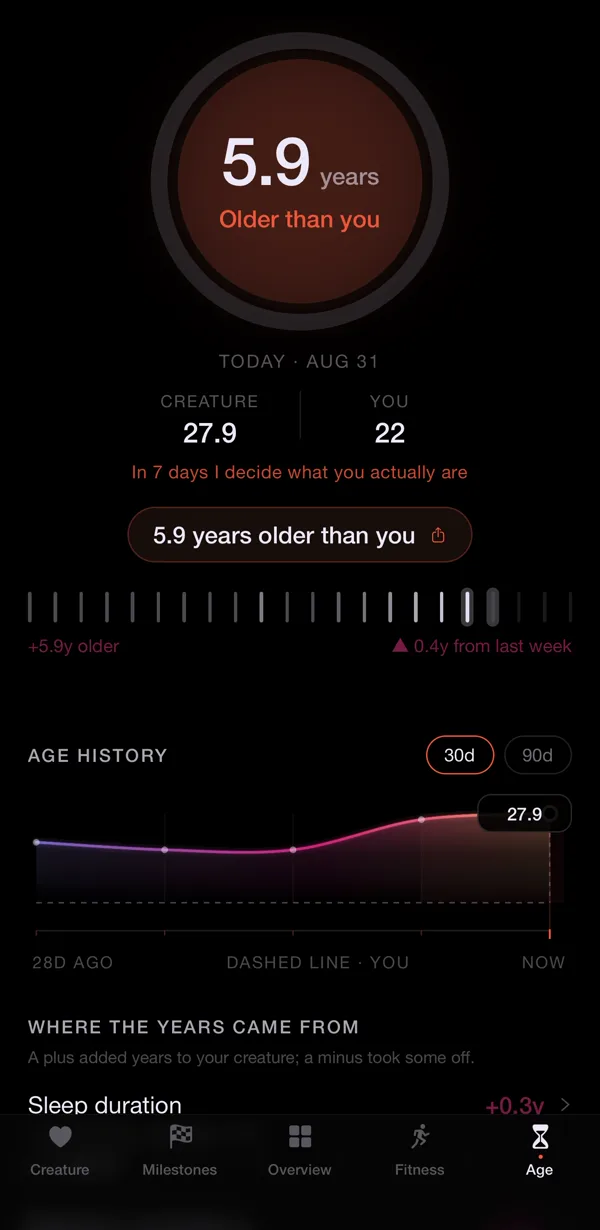
To be plain about what it is: Creature Age is a for-fun number built from public-health guidelines. It is not a biological age test, not an epigenetic clock and not medical. The creature also does not coach you on how to bring it down. It judges, and that is the whole job. If you want other apps where a pet reacts to your health data, see our list of virtual pet apps that use Apple Health.
The honest limitation: it is not free. Nularo is a subscription ($39.99 a year with a 3-day free trial, or $9.99 a month), and it is iPhone only. Without an Apple Watch, Apple Health has far less sleep and heart data to give it, and the number gets thinner. It also reflects last week, not this minute. If the breakdown says sleep is the habit adding the most years, our guide on whether Apple Watch tracks sleep debt explains what your watch records about it.
Sources
- Apple Support: Track your cardio fitness levels
- Apple Newsroom: Apple advances health and fitness capabilities using Apple Intelligence (September 2026)
- National Institute on Aging: Epigenetic age estimated by changes in DNA methylation
- Bevel Help Center: Membership and pricing
Try Nularo
Frequently asked questions
Is there a free biological age app for Apple Watch?
The closest free, built-in option is Cardio Fitness in the Health app, which rates your VO2 max against your age and sex. Apple's Health Age will be part of the Health app once the redesign ships. Most third-party biological age apps are free to download but put the age score, or the detailed version of it, behind a subscription.
Where do I find Health Age on my iPhone?
Apple says Health Age will live in a new Longevity tab in the redesigned Health app. iOS 27.2, released October 26, 2026, does not include it. It needs an Apple Intelligence capable iPhone, starts in U.S. English, and Health Age itself requires an Apple Watch.
Can I see Whoop Age on an Apple Watch?
No. Whoop Age is part of Whoop's Healthspan feature and is built from data recorded by a Whoop band. It is available to Whoop Peak and Whoop Life members once you have logged 21 recoveries in a 31-day period.
Is an app's biological age the same as an epigenetic test?
No. Epigenetic clocks are calculated from DNA methylation in a sample of your cells. Watch-based ages are estimates built from behaviour and fitness metrics. They measure different things and can disagree.
Is Nularo's Creature Age a medical measurement?
No. Creature Age is a rules-based, for-fun number built from public-health guidelines on sleep and movement, plus your resting heart rate and HRV trends. It is not a diagnosis and it is not a biological age test.
Nularo is an entertainment and wellness app, not a medical device. Nothing on this page is medical advice. If something about your sleep or heart worries you, talk to a doctor.