Free stress apps for Apple Watch: what they actually measure
Updated October 30, 2026 · 7 min read · How we write these
 Nularo reads your Apple Health and turns it into a creature that reacts to how you really slept and moved.
Get it
Short answer
Apple Watch has no built-in stress score, even in watchOS 27. The free built-in tools are State of Mind, a mood log in the Mindfulness app, and Reflect and Breathe sessions. For an actual 0 to 100 stress number, Bevel and Athlytic both offer one in their free tiers, built from your heart rate and HRV in Apple Health. Welltory's free tier allows one Apple Watch measurement a day. All of them estimate stress from your body's signals; none can read your mind.
Your friend's Garmin buzzes to tell her she is stressed. You scroll through every app on your Apple Watch looking for the same thing and find a Breathe animation and a mood slider. Then the App Store offers you thirty apps called "Stress" something, all marked free, most with a subscription one screen later.
Apple Watch has no stress score (and what it has instead)
Apple Watch does not give you a stress number. Not in watchOS 26, and not in watchOS 27, whose health additions included Readiness on the newest watches, Workout Buddy coaching and cycle tracking changes. The watch collects the raw signals stress apps rely on, mainly heart rate and heart rate variability (HRV), but Apple stops short of labeling any of it "stress".
What you get for free is in the Mindfulness app:
- State of Mind. A log of how you feel, which you fill in yourself. Open Mindfulness on the watch, tap State of Mind, then choose "Log how you're feeling right now" for a momentary emotion or "Log how you've felt overall today" for a daily mood. Turn the Digital Crown to set how pleasant or unpleasant it was, then add words and what is having the biggest impact if you want.
- Reflect and Breathe. Short guided sessions. Breathe paces your breathing with an animation that grows and shrinks; Reflect gives you a theme to focus on. Apple says the watch measures your heart rate during these sessions, and you can review it later in the Health app.
State of Mind is the part most stress apps skip. On iPhone, open Health, tap Browse (Search on some versions), then Mental Wellbeing, then State of Mind. Tap Show in Charts and choose Life Factors to put your logs next to sleep, exercise, time in daylight and mindful minutes. That is the only place Apple connects how you felt with what your watch recorded, and it is free. The catch is that it only knows what you tell it.
The same Mental Wellbeing section holds Apple's depression and anxiety questionnaires (the PHQ-9 and GAD-7). Apple is clear these estimate risk and are not a diagnosis, and that only a clinician can make one.
What a "stress score" on Apple Watch is really measuring
Every third-party stress app for Apple Watch works the same basic way. It reads heart rate and HRV from Apple Health, builds a picture of your normal over a few days or weeks, and calls it stress when your heart beats faster, or more evenly, than usual while you are not exercising.
That gives these scores two blind spots worth knowing before you install anything.
They cannot tell why. A deadline raises your heart rate. So does a double espresso, a hot room, a cold coming on, a bad night or standing up from the sofa. The app sees the same signal either way. This is why a stress app can call you stressed on a relaxed Sunday and calm in the middle of a tense meeting.
They depend on how often the watch measures. On most Apple Watch models, HRV is sampled only now and then, while you are still, and no app can change that. Apple says Series 12 and Ultra 4 measure it as often as every five minutes. On an older watch, an app's "real-time" stress line is drawing between a small number of readings. Apple's HRV also uses a different formula from Whoop or Garmin, which is why your Apple Watch HRV can look low next to theirs, and why stress scores from different brands do not line up.
So use any stress score the way you would use a weather forecast for your body: a trend worth noticing, not a verdict on your mental state.
Free stress apps that read Apple Health
These three have stress scores you can actually use without paying, according to their App Store listings and their developers' help pages in October 2026. All three read Apple Watch data through Apple Health.
| App | Free stress feature | Built from | The catch |
|---|---|---|---|
| Bevel | 0 to 100 Stress score through the day | Heart rate and HRV, accounting for movement | Pro is for extras like its AI assistant |
| Athlytic | 0 to 100 Stress score, watch complication, optional alerts | Heart rate while inactive vs your resting heart rate | Pro unlocks other features ($29.99 a year) |
| Welltory | Stress and energy readout from an HRV measurement | HRV | One Apple Watch measurement a day on the free tier |
Bevel is the most generous. Its App Store listing describes a real-time Stress score from 0 to 100 and says stress patterns show up during sleep, workouts and the rest of the day. Bevel's help pages describe it as a measure of mental stress based on heart rate and HRV while accounting for movement. A December 2025 update made almost every feature free, and the Stress score is still on the free plan after the April 2026 Bevel 3.0 update moved its AI assistant, Biological Age and Health Records into a $99.99-a-year Pro plan (our guide to free Bevel alternatives covers what each of those costs elsewhere). It also has an Energy Bank gauge, covered in our guide to the closest thing to a Body Battery on Apple Watch.
Athlytic is the most transparent about its math. Its help docs say Stress is only scored while you are inactive (sleeping, resting, working at a desk) and compares your heart rate in those periods with your resting heart rate, on a 0 to 100 scale where 0 to 25 is Low and 26 to 50 is Moderate. You can turn on stress notifications from the More tab and pick the level that triggers them; Athlytic says they are sent at most once an hour and not within 30 minutes of a workout. A release note says stress does not need a subscription. Athlytic Pro, for its other features, is $4.99 a month or $29.99 a year.
Welltory is free to download, but its help center says free users get one Apple Watch measurement a day (counted from 5am to 5am), whether automatic or taken through Breathe, and data older than 30 days is deleted on the free tier. Fine for a single morning check. Thin for watching a whole day.
The dozens of smaller apps called "Stress Watch" or "Stress Tracker" mostly follow the same HRV recipe and are "free with in-app purchases", which usually means a trial and then a subscription. Check the In-App Purchases list on the listing before you hand over Health access.
Making a free stress app worth looking at
- Give it a week. Bevel and Athlytic both compare you with your own baseline, which takes time to build. The first few days are guesses.
- Wear the watch to bed. Night is when you are still the longest, so most HRV readings, and the most comparable ones, come from sleep. Sleep also feeds most of these apps' recovery numbers; our guide to apps that rate your sleep shows what each one counts.
- Check the fit. Apple says the band should be snug but comfortable, above the wrist bone, so the sensor stays against your skin.
- Pair it with State of Mind. Log a daily mood in the Mindfulness app for a couple of weeks. If the app's high-stress days and your bad-mood days line up, the score is telling you something. If they never do, you have learned that too.
- Keep alerts rare. A watch that buzzes "you are stressed" during a stressful day is not always helping. Athlytic lets you raise the alert threshold or turn alerts off.
If a stress app keeps flagging you as high for weeks, or you feel anxious or low most days whatever the score says, that is a conversation for a doctor, not a setting to adjust.
Where Nularo fits
Nularo is an iPhone app with a small creature that lives on your Apple Health data. It reads HRV, resting heart rate, sleep, sleep stages, steps, active minutes and workouts, read-only, and you never log anything. Each morning it turns all that into Sleep, Stress and Energy scores and a verdict notification, and the creature lands in one of four moods (glowing, fine-but-judgy, wrecked or suspicious) set against your own 14-day baseline rather than anyone else's numbers.
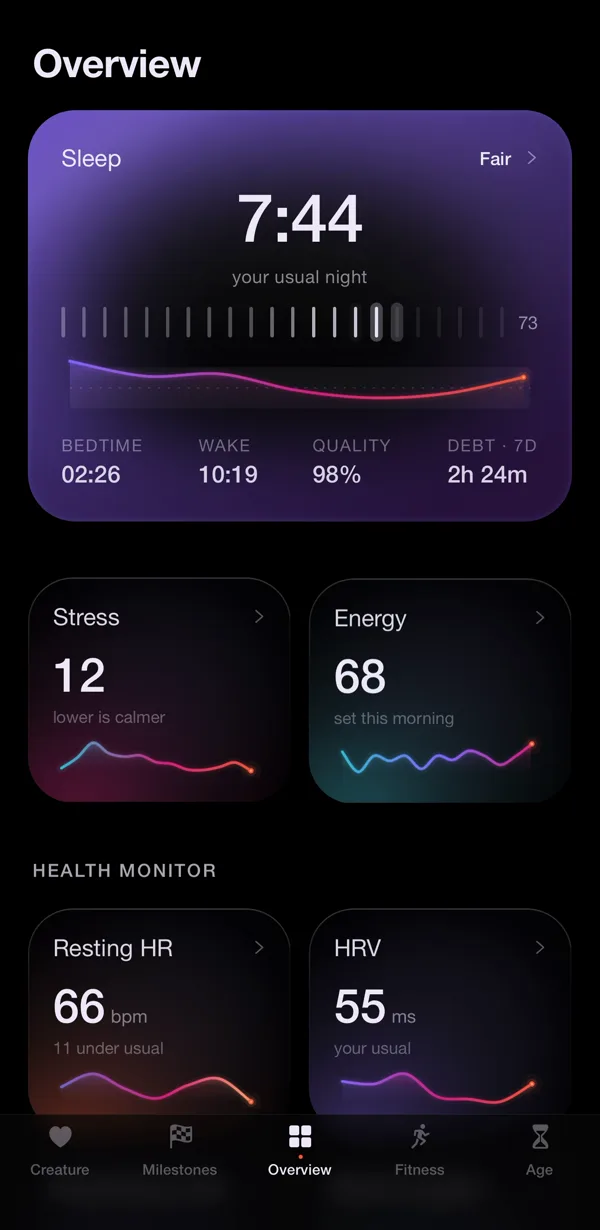
The Overview tab, shown above, puts Stress next to Sleep and Energy, so a high-stress morning sits beside the short night that probably came with it. There is also a running sleep debt, which our guide to whether Apple Watch tracks sleep debt explains. It judges, it does not coach: no breathing prompts, no advice. In friend mode a friend sees only your mood word and a good-day count, never your stress number, as our guide to sleep tracking with a partner or friends covers.
The honest limitation: Nularo is a morning-after read, not a live stress gauge. It will not buzz your wrist during a tense afternoon the way Athlytic can, and it is not free. It is iPhone only, works best with an Apple Watch writing HRV to Apple Health, and costs $39.99 a year with a 3-day free trial, or $9.99 a month. If you want a free stress line through the day, use Bevel or Athlytic.
Sources
- Apple Support: Log your state of mind on Apple Watch
- Apple Support: Log your state of mind in Health on iPhone
- Apple Support: Start a Reflect or Breathe session on Apple Watch
- Athlytic Help: Getting started
- Welltory Help: Taking measurements with your Apple Watch
Try Nularo
Frequently asked questions
Does Apple Watch measure stress?
Not as a score. Apple Watch records heart rate and heart rate variability, which stress apps use, but Apple itself does not turn them into a stress number. Its built-in options are State of Mind logging and Reflect and Breathe sessions in the Mindfulness app.
What is the best free stress app for Apple Watch?
Bevel and Athlytic both include a 0 to 100 stress score in their free tiers, according to their App Store listings and help pages. Athlytic only scores stress while you are inactive. Welltory is free to download but limits free users to one Apple Watch measurement a day.
Why does my stress app say I am stressed when I feel fine?
These apps read your body, not your mood. Caffeine, heat, a stuffy room, a cold coming on or simply standing up can all raise heart rate or lower HRV. Treat a high reading as a body signal, and look at the trend over days rather than one spike.
Are the free stress apps in the App Store accurate?
None of them are medical devices, and most say so in their listings. They estimate stress from Apple Watch heart rate and HRV, and the watch only samples HRV now and then on most models. If stress or anxiety is affecting your life, talk to a doctor rather than relying on an app.
Does Nularo have a stress score?
Yes. Nularo shows Sleep, Stress and Energy scores each morning from your Apple Health data, next to a creature whose mood is set against your own 14-day baseline. It is a morning-after read, not a live gauge, and it has no watch alerts. It costs $39.99 a year with a 3-day free trial, or $9.99 a month.
Nularo is an entertainment and wellness app, not a medical device. Nothing on this page is medical advice. If something about your sleep or heart worries you, talk to a doctor.