Apps that rate your sleep: how each one grades a night
Updated October 30, 2026 · 7 min read · How we write these
 Nularo reads your Apple Health and turns it into a creature that reacts to how you really slept and moved.
Get it
Short answer
If you wear an Apple Watch to bed, you already have one: with watchOS 26 or later, the Sleep app rates each night from 0 to 100 (duration 50 points, bedtime consistency 30, interruptions 20). On iPhone, open Health, tap Search, then tap Sleep. Apps add other grades on top: AutoSleep scores you against goals you set, Bevel gives a free 0-100% Sleep Score, and Sleep Cycle and SleepScore rate your night with just the phone, no watch. Scores from different apps are not comparable.
You slept seven hours, you feel like you slept four, and you want something to settle the argument. A number. A grade. Preferably one that does not require you to type anything at 7 a.m. Here is what rates your sleep on an iPhone, and what each grade is actually made of.
Your Apple Watch already rates every night
Before downloading anything, check what you have. Since watchOS 26, Apple Watch gives each night a Sleep Score from 0 to 100. Apple builds it from three parts:
- Duration, 50 points. How long you slept.
- Bedtime consistency, 30 points. How close your time of falling asleep was to the last 13 nights. Other apps judge sleep consistency over 4 days or two weeks, or count wake time too.
- Interruptions, 20 points. How often you woke up and how long you stayed awake.
Apple then puts the number in a band: Very Low (0 to 40), Low (41 to 60), OK (61 to 80), High (81 to 95) and Very High (96 and above). It needs watchOS 26 on an Apple Watch Series 6 or later, SE (2nd generation) or later, or any Ultra, paired with an iPhone 11 or later on iOS 26.
Where to see it: in the morning, open the Sleep app on your watch and tap the Info button for the breakdown by part. You can also add it to the Smart Stack or a watch face as a complication. On iPhone, open the Health app, tap Search, then tap Sleep.
Two things the score leaves out are worth knowing. First, sleep stages. Deep and REM sleep appear in the Health app (our guide to reading the Apple Watch sleep graph explains each stage), but they are not one of the three parts, so a night with lots of deep sleep does not earn extra points. Time in bed is not in there either; Apple stopped recording it on watchOS 11, which is why Apple Watch time in bed can be missing or less than time asleep. Second, history beyond the night. A short Monday does not drag down Wednesday's duration points; if you want the running total, that is sleep debt, which Apple does not track. Sleep is also one of the inputs to Apple's upcoming Health Age, though you cannot see Apple Health Age yet, even on iOS 27.2.
Why one night gets four different grades
Run two sleep apps side by side and they will rarely agree. Apple might say 72 while another app says 89 for the same night. Neither is wrong; they are not grading the same test. Every score is a weighted mix of a few inputs, and each app picks its own mix:
| App | What the score is built from | Needs a watch? | Price (US) |
|---|---|---|---|
| Apple Sleep Score | Duration, bedtime consistency over 13 nights, interruptions | Yes | Built in |
| AutoSleep | Its sleep rings (duration, quality, deep sleep, heart rate), measured against your own goals | Yes | $9.99 once |
| Bevel | Sleep stages, duration and interruptions, as a 0-100% score | Yes | Free (Pro is optional) |
| Sleep Cycle | Time in bed, deep sleep, movement and times fully awake, calibrated to you | No, uses the phone | Free, Premium optional |
| SleepScore | A 0-100 score from the phone's own sensing of breathing and movement | No, uses the phone | Free, premium optional |
The practical rule: pick one score and watch its trend. Comparing a number from one app with a number from another tells you about the apps, not about your night. The same goes for the heart data behind some of these scores; Apple Watch HRV runs lower than Whoop or Oura because they measure it differently.
Apps that grade you with an Apple Watch
AutoSleep (Tantsissa) is the long-running Apple Watch sleep app. Its developer guide describes a Sleep Rating from 1 to 100 calculated from its sleep rings, with red for poor, green for good and blue for exceptional. The rings are duration, quality, deep sleep and sleeping heart rate, and the rating is how close you came to your goals for each. That last part matters: lower your goals and your rating goes up, so set them honestly. The developer suggests 70 to 80% as a good starting target for the quality ring, which is driven mostly by how much you moved. It costs $9.99 once, with no subscription.
Bevel gives a Sleep Score as a percentage from 0 to 100, summarising sleep quality and efficiency from your stages, duration and interruptions. Bevel's help center says the free tier includes Sleep along with Recovery, Strain and Stress (the closest thing to a Body Battery for Apple Watch), and since the Bevel 3.0 update, Pro ($99.99 a year) is only needed for extras like its AI assistant and Biological Age, as our guide to free Bevel alternatives breaks down. It is the cheapest way to get a second opinion that does count your sleep stages. Its Stress score is one of the few you can get without paying, as our roundup of free stress apps for Apple Watch shows.
Athlytic does not lead with one sleep grade. Its sleep section shows sleep performance, stages, consistency, latency, efficiency, sleep debt and overnight heart rate, HRV and blood oxygen. It suits people who want the parts more than the total. It is free with a Pro subscription at $4.99 a month or $29.99 a year, and needs an Apple Watch for most features.
If you want the grade to turn into points, streaks or Pokémon, those are a different kind of app, covered in gamified sleep tracker apps. Pokémon Sleep, for example, only gives 100 points for 8 hours 30 minutes or more.
Apps that grade you with just your iPhone
No watch, or you hate wearing one to bed? A phone on the nightstand can still produce a score, with less to go on.
Sleep Cycle tracks with the microphone or the motion sensor; the company says the microphone gives the best results. Its support pages say the sleep quality score combines time in bed, time in deep sleep, how often and how much you moved, and how many times you were fully awake. It calibrates on the first night and adjusts to your own data over time, so it is partly grading you against yourself. Sleep Cycle calls its sleep staging an estimate, not a medical measurement, which is the right way to read every app on this page.
SleepScore uses only the phone and rates each night from 0 to 100, with a premium subscription for extra insights and advice. Do not confuse it with SleepScore Max, a separate product that needs its own bedside device.
Phone-only scores are fine for spotting a pattern, like your score dropping every Sunday night. They are weaker at telling you what happened in the night, because the phone is guessing from sound and movement rather than reading your pulse.
Where Nularo fits
Full disclosure: Nularo is our app, and it rates your sleep in a less polite way. It reads Apple Health read-only (sleep, sleep stages, steps, active minutes, workouts, resting heart rate, HRV, respiratory rate and SpO2), so it uses whatever your watch already recorded and you never log anything. Each morning you get a verdict notification written from last night's numbers, a Sleep score alongside Stress and Energy, and a creature in one of four moods: glowing, fine-but-judgy, wrecked or suspicious.
The difference from the scores above is the yardstick. The mood is set against your own 14-day baseline rather than a fixed target, so a night that is normal for you reads as normal, and a night that is bad for you gets called out even if it would pass someone else's test. The Today screen below shows last night's numbers next to the creature's opinion of them.
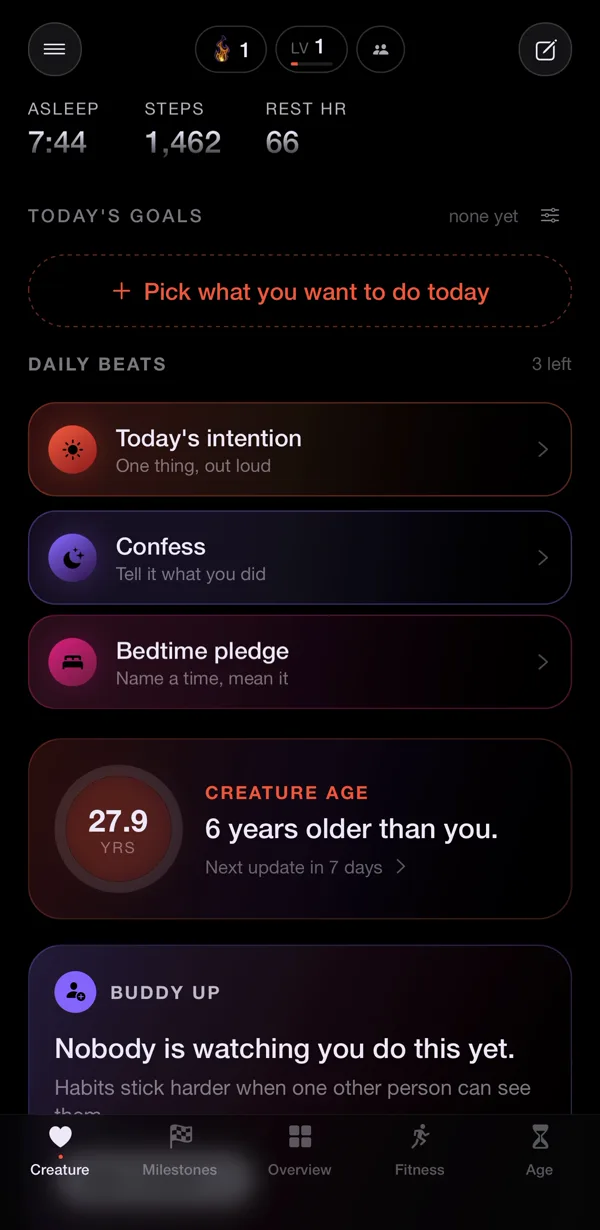
There is also a 7-day sleep debt, a Bedtime Pledge for tonight and a Weekly Report Card that grades the whole week. If you sleep in the daytime after shifts, see sleep apps for night shift workers first, since every score here depends on how your sleep is scheduled.
The honest limitations: it is iPhone only and works from Apple Health, so without a watch on at night it has much thinner data to rate. It updates the morning after, not in real time. It judges, it does not coach, so you get a verdict, not a plan. And it is a subscription with a paywall after onboarding: $39.99 a year with a 3-day free trial, or $9.99 a month.
What a sleep score can and cannot tell you
A score is a summary of what a sensor estimated. It is good at trends: whether this week is worse than last, whether late nights cost you, whether your bedtime is drifting. It is not a diagnosis. None of these apps can tell you whether you have a sleep disorder, and a high score does not rule one out. If you are tired all the time no matter what the number says, or someone tells you that you stop breathing at night, talk to a doctor.
Sources
- Apple Support: View your sleep score on Apple Watch
- Apple Support: Track your sleep on Apple Watch and use Sleep on iPhone
- Sleep Cycle: How does the app calculate Sleep Quality?
Try Nularo
Frequently asked questions
Is there a free app that rates your sleep?
Yes. Apple's Sleep Score is built into Apple Watch with watchOS 26 and costs nothing. Bevel's Sleep Score is also free; Bevel's paid Pro plan covers its AI assistant, Biological Age, Health Records and training plans. Sleep Cycle and SleepScore are free to download with paid premium tiers.
What is a good Apple Watch Sleep Score?
Apple sorts the score into bands: Very Low (0 to 40), Low (41 to 60), OK (61 to 80), High (81 to 95) and Very High (96 and above). Because duration is worth 50 of the 100 points, a short night caps your score even if you slept soundly.
Can an app rate my sleep without an Apple Watch?
Yes. Sleep Cycle tracks with the iPhone microphone or motion sensor, and SleepScore uses the phone alone. Apple's own Sleep Score needs an Apple Watch. Phone-only tracking has less to work with than a watch on your wrist, so treat its stages as estimates.
Why do my sleep apps give different scores for the same night?
Each app weighs different things. Apple's score does not include sleep stages at all, AutoSleep grades you against goals you set yourself, and Sleep Cycle calibrates to your own past nights. A 78 in one app and an 88 in another can describe the same sleep.
Does Nularo rate your sleep?
Yes, in its own way. Nularo reads your sleep from Apple Health, shows a Sleep score, and each morning sends a verdict with a creature mood (glowing, fine-but-judgy, wrecked or suspicious) set against your own 14-day baseline. It is iPhone only and a subscription: $39.99 a year with a 3-day free trial, or $9.99 a month.
Nularo is an entertainment and wellness app, not a medical device. Nothing on this page is medical advice. If something about your sleep or heart worries you, talk to a doctor.