Sleep consistency apps: what each one actually measures
Updated October 30, 2026 · 7 min read · How we write these
 Nularo reads your Apple Health and turns it into a creature that reacts to how you really slept and moved.
Get it
Short answer
If you wear an Apple Watch to bed, you already have one. Since watchOS 26, 30 of the 100 points in Apple's Sleep Score are bedtime consistency, based on when you fell asleep over the last 13 nights. Open the Sleep app on the watch and tap the Info button to see it. Apple only looks at when you fall asleep, not when you wake. For wake time too, Bevel (free) scores sleep timing over 7 days, and Whoop and Oura score it with their own hardware.
You slept 7 hours 40 minutes on Saturday and still feel off on Monday. The total looks fine. The timing is what moved: asleep at 1 AM on the weekend, 11 PM on a work night. You want an app that notices that, ideally without you typing anything. Here is what tracks sleep consistency on an iPhone, and what each one means by the word.
Your Apple Watch already scores consistency
Since watchOS 26, Apple Watch gives each night a Sleep Score from 0 to 100, and consistency is a big part of it. Apple splits the points three ways:
- Duration, 50 points. How long you slept.
- Bedtime consistency, 30 points. Apple says this considers when you fell asleep during the last 13 nights.
- Interruptions, 20 points. How often you woke up and for how long.
To see it, open the Sleep app on your watch in the morning and tap the Info button for the breakdown. On iPhone, open the Health app, tap Search (Browse on some versions), then tap Sleep. The score needs an Apple Watch Series 6 or later, SE (2nd generation) or later, or any Ultra, on watchOS 26. Our guide to apps that rate your sleep covers the rest of the score and how it compares with other apps.
Two details matter for consistency specifically. First, Apple measures when you fell asleep, not when you got into bed and not when you woke up. A night where you went to bed on time and lay awake for an hour can still cost you points. Second, the yardstick is your own last 13 nights, not a fixed "good" bedtime. Someone who reliably falls asleep at 1 AM can score well. Apple does not publish how the 13 nights are turned into points, so nobody outside Apple can tell you exactly what a 45-minute slip costs.
If you want to see the pattern rather than the points, open Sleep in the Health app and tap W or M at the top of the chart. The week and month views put your nights side by side, so a drifting bedtime is easy to spot.
Three different things called "consistency"
Search for a sleep consistency app and you will find a dozen that claim to measure it. They are not measuring the same thing. Roughly, they fall into three kinds:
- Bedtime only. How close tonight's sleep onset is to your recent bedtimes. Apple's 30 points work this way, and so does Athlytic, which defines it as the average time you actually fell asleep over the past 7 days.
- Bedtime and wake time. Both ends of the night count. Oura's Sleep regularity contributor looks at how consistent your bedtime and wake-up times have been over the previous two weeks, and naps do not affect it.
- Overlap, minute by minute. Whether you are asleep or awake at the same clock times from one day to the next. This is the idea behind the Sleep Regularity Index, a research measure from a 2017 study in Scientific Reports: the probability of being in the same state 24 hours apart, scored so that an identical routine every day gives 100. Whoop and Bevel both describe their consistency scores in these terms.
| Source | What counts | Window | Needs |
|---|---|---|---|
| Apple Sleep Score | When you fell asleep | Last 13 nights | Apple Watch, watchOS 26 |
| Athlytic | Average time you fell asleep | Past 7 days | Apple Watch |
| Bevel | Stability of sleep and wake timing | Past 7 days | Apple Health data |
| Whoop | Same sleep or wake state at the same clock time | 4 days | Whoop strap |
| Oura | Bedtime and wake-up time | Previous two weeks | Oura ring |
The window explains most disagreements. One late Saturday is a quarter of Whoop's 4 days and under a tenth of Apple's 13 nights, so Whoop will punish it hard on Sunday and forget it by Thursday, while Apple barely flinches and remembers for two weeks. Neither is wrong. Pick one and watch its trend.
Apps that track consistency from Apple Health
These are apps whose consistency features we could confirm on their App Store listing or the developer's own documentation in October 2026. All of them read the sleep your watch writes to Apple Health, so nothing needs logging by hand.
Bevel is the most interesting free option. Its own explanation says it looks at the past 7 days of sleep and scores each day on how stable your timing is, and it names the Sleep Regularity Index as the research idea behind it. That same consistency feeds into Bevel's biological age, which averages the daily scores over about a month so one bad week does not swing it. The consistency score is on Bevel's free plan, but Biological Age now needs Bevel Pro; our guide to free Bevel alternatives lists what else moved behind the paywall. If biological age is what you are after, our guide to biological age apps for Apple Watch compares how each one is built.
AutoSleep (Tantsissa) lists Sleep Consistency on its App Store page as a way to learn your time-to-bed behaviour, and a release note says it was added to the Today tab to help monitor bedtime routines. It also has Tonight's Bedtime, which recommends a bedtime based on your recent habits. It is a one-time purchase, $9.99 in the US, with no subscription.
Athlytic tracks Sleep Consistency and sleep debt alongside its recovery scores, and uses the 7-day average to work out a target bedtime. One catch from its own help docs: consistency and sleep latency need "In Bed" samples in Apple Health. Apple stopped recording In Bed samples on watchOS 11 and iOS 18, so if your sleep data only has asleep stages, those two figures can come up empty; there is more on that change in why Apple Watch time in bed is missing. It is free with a Pro subscription.
Sleep Cycle Bedtime Calculator (a different app from the main Sleep Cycle) has a Sleep Consistency chart that shows how often you go to bed within 30 minutes of your average bedtime, using sleep data from Apple Health. It is the simplest version of the idea, and the 30-minute window is easy to read.
Peaks: Sleep & Energy builds consistency into its nightly score. Its release notes describe a Consistency Score for how regular your bed and wake times are, one of five parts of the Sleep Score, and a Regularity Score in Insights that shows how much your wake time shifts across the week.
Whoop and Oura both score consistency well, but they need their own strap or ring, so they are not an add-on to an Apple Watch you already own.
Why irregular weeks show up everywhere
Consistency gets its own score because researchers keep finding it matters separately from how long you sleep. In a UK Biobank study of about 61,000 people with 7 days of wrist-worn activity data, published in Sleep, sleep regularity predicted mortality risk more strongly than sleep duration did. That is a population finding from one week of data per person, not a verdict on your Tuesday. It does explain why every app above treats a drifting bedtime as worth flagging, even when your total hours look fine.
It also explains why consistency scores react badly to some lives. If you work shifts, a rota change will drag every one of these numbers down for a while; see sleep apps for night shift workers for how to set up Apple's schedules for daytime sleep. And short nights add up separately from irregular ones; the running total is sleep debt, which Apple does not track.
None of these apps can diagnose a sleep problem. If your sleep timing is erratic because you cannot fall asleep or stay asleep, talk to a doctor rather than an app.
Where Nularo fits
Full disclosure: Nularo is our app. It does not hand you a consistency percentage. It treats bedtime consistency as one habit among several and lets a creature have opinions about it.
Nularo reads Apple Health read-only (sleep, sleep stages, steps, active minutes, workouts, resting heart rate, HRV, respiratory rate and SpO2), so you log nothing. Its Creature Age is recalculated weekly from sleep duration, bedtime consistency, steps, active minutes, resting heart rate and HRV, with a per-habit breakdown of the years each one adds. A week of all-over-the-place bedtimes shows up as years on that line, as on the Age tab below. Creature Age is a rules-based, for-fun number built from public-health guidelines, not a medical measure, and it stays hidden until there are 7 days of data.
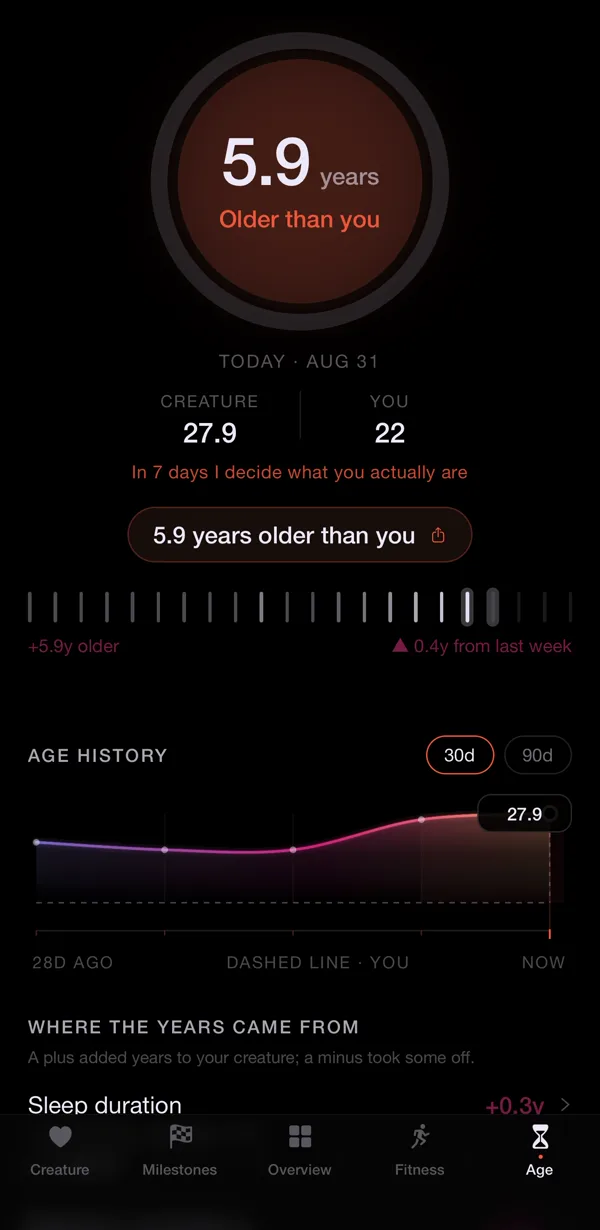
For the evening end, there is a Bedtime Pledge for tonight, and each morning a verdict notification arrives written from last night's numbers. The creature's mood (glowing, fine-but-judgy, wrecked or suspicious) is set against your own 14-day baseline. If you would rather be held to it by someone else, friend mode shares a mood word and a good-day count, never health numbers; more in sleep tracking with a partner or friends.
The honest limitation: Nularo judges, it does not coach. It will tell you the week went sideways, not build a schedule to fix it. It is iPhone only, it needs a watch on at night for good sleep data, it reports the morning after rather than in real time, and it is a subscription with a paywall after onboarding: $39.99 a year with a 3-day free trial, or $9.99 a month.
Sources
- Apple Support: View your sleep score on Apple Watch
- Apple Support: View your sleep history in Health on iPhone
- Phillips et al. (2017), Scientific Reports: Irregular sleep/wake patterns and the Sleep Regularity Index
- Windred et al., Sleep: Sleep regularity is a stronger predictor of mortality risk than sleep duration
Try Nularo
Frequently asked questions
Does Apple Watch track sleep consistency?
Yes, as part of the Sleep Score in watchOS 26 and later. Bedtime consistency is worth 30 of the 100 points, and Apple says it considers when you fell asleep over the last 13 nights. It does not score your wake time, and Apple does not publish the exact formula.
Is there a free sleep consistency app?
Apple's Sleep Score is built into Apple Watch at no cost. Bevel's free plan scores the regularity of your sleep timing from Apple Health. Athlytic tracks sleep consistency with a free tier and an optional Pro subscription.
What is the Sleep Regularity Index?
It is a research measure introduced in a 2017 study in Scientific Reports. It asks how likely you are to be in the same state, asleep or awake, at the same minute 24 hours apart. Someone who sleeps and wakes at exactly the same time every day scores 100. Whoop and Bevel describe their consistency scores in similar terms.
Why do two apps give me different consistency scores?
They measure different things over different windows. Apple looks at when you fell asleep over 13 nights. Whoop compares sleep and wake states over 4 days. Oura looks at bedtime and wake time over two weeks. A late Saturday hits a 4-day window much harder than a 13-night one.
Does Nularo track sleep consistency?
Bedtime consistency is one of the habits in Nularo's Creature Age, recalculated weekly, with a breakdown of how many years each habit adds or takes off. There is also a Bedtime Pledge you make in the evening. Nularo is iPhone only and a subscription: $39.99 a year with a 3-day free trial, or $9.99 a month.
Nularo is an entertainment and wellness app, not a medical device. Nothing on this page is medical advice. If something about your sleep or heart worries you, talk to a doctor.