Does Apple Watch have a Body Battery? (The closest equivalents)
Updated October 19, 2026 · 7 min read · How we write these
 Nularo reads your Apple Health and turns it into a creature that reacts to how you really slept and moved.
Get it
Short answer
No. Body Battery is Garmin's. Apple's closest match is Readiness, a 0-10 score in watchOS 27 that only works on Apple Watch Series 12 and Ultra 4: open the Readiness app on the watch, or Fitness on iPhone and tap Readiness. Older watches get the pieces without one number: the Vitals app, HRV and resting heart rate in Health (Browse, Heart), and Training Load in the Activity app. Apps like Bevel, Athlytic and Vigor combine them into a battery-style gauge.
You switched from a Garmin, or a friend keeps quoting her Body Battery at you over coffee, and now you are scrolling through your Apple Watch looking for the same number. It is not there under that name. Here is what is.
What Garmin's Body Battery actually is
Body Battery is Garmin's own feature (garmin.com lists it as Body Battery™), so no other company ships it under that name. Garmin's owner's manuals describe it as an estimate of your energy reserve, worked out from four things the watch already tracks: heart rate variability, stress level, sleep quality and activity.
The level runs from 5 to 100. Garmin's bands in current manuals are:
- 5 to 25: very low reserve energy
- 26 to 50: low reserve energy
- 51 to 75: medium reserve energy
- 76 to 100: high reserve energy
Garmin says good sleep charges it, while strenuous activity and high stress drain it faster. It also says food and caffeine have no impact on it, and that wearing the watch to sleep gives more accurate results. The key thing people like about it is the shape: one number that fills up overnight and ticks down through the day, like a phone battery.
Apple Watch collects most of the same raw signals. For years it just did not combine them into one gauge. That changed this fall, but only for some watches.
The closest built-in answer: Readiness, on new watches only
With watchOS 27, Apple added a Readiness app. According to Apple's support pages it is available on Apple Watch Series 12 and Apple Watch Ultra 4 only, for ages 13 and older. Series 11, Ultra 3, SE 3 and earlier models do not get it, even though watchOS 27 runs on several of them.
Readiness gives you a single score from 0 to 10 with a label:
- 0 to 1: Recover
- 2 to 4: Pace Yourself
- 5 to 7: Ready
- 8 to 10: Go For It
Apple says the score draws on three areas. Activity covers active calories, workout effort ratings and Training Load. Vitals covers your overnight and daytime readings from the Vitals app, and the score drops when those readings are slightly or notably off your usual range. Sleep uses last night's sleep score plus your recent history. Like Body Battery, it changes during the day: Apple notes it factors in calories burned, naps and daytime heart rate, so it can drop after a workout.
To see it, open the Readiness app on the watch. On iPhone, open the Fitness app and tap Readiness (you may need to scroll to the bottom). Before it works you need your height, weight and age entered, Activity and Sleep set up, Overnight Vitals turned on, and at least 7 nights of wearing the watch to bed. Apple is clear that Readiness does not account for things like existing conditions or medications, and that it is a general wellness feature.
So if you own a Series 12 or Ultra 4, this is your Body Battery equivalent. It is coarser (11 steps instead of 96) and framed around how hard to push, not how much charge is left.
What older Apple Watches can show you instead
On any other watch you get the ingredients but no single number. Here is where each one lives.
Vitals app. Open Vitals on the watch to see last night's heart rate, respiratory rate, blood oxygen, wrist temperature and sleep duration against your own typical range. Apple says you need about 7 nights of sleep tracking to build that range. On iPhone: Health, Browse, Vitals. This is the closest thing to a "did I recharge?" check on older watches. (Blood oxygen is not on SE models, and wrist temperature needs Series 8 or later or any Ultra.)
HRV and resting heart rate. Both feed Body Battery and Readiness. On iPhone, open Health, tap Browse, then Heart, and pick Heart Rate Variability or Resting Heart Rate. A single reading means little. The trend against your own normal is what these scores are built on. Apple's HRV is also on a different scale from Garmin's or Whoop's, which is why your Apple Watch HRV can look low next to theirs.
Training Load. In the Activity app on the watch, tap the Workload button and turn the Digital Crown. Apple compares the intensity and duration of your last 7 days of workouts with the previous 28 days, on a scale from well below to well above. This is the "drain" side of the battery idea.
Sleep score. The Sleep app gives a 0 to 100 score each morning, weighted 50 points for duration, 30 for bedtime consistency and 20 for interruptions. If short nights are your main drain, our guide to whether Apple Watch tracks sleep debt covers what Apple counts and what it does not.
Apps that build a body-battery-style score from Apple Health
If you want one gauge on an older watch, or one that runs 0 to 100 like Garmin's, third-party apps fill the gap. All of these read Apple Watch data. Prices are from the US App Store in October 2026.
- Bevel. Its Energy Bank is described on the App Store as "your body's battery", combining recovery, sleep, strain and stress into one metric that builds and drains through the day. It also has separate Recovery and Stress scores (we compare free stress apps for Apple Watch in their own guide). Free to download; Bevel Pro is $14.99 a month or $99.99 a year.
- Athlytic. Its Battery and Stress section lets you "watch your energy fill and drain through the day", next to a Recovery score (overnight HRV and resting heart rate against your baseline) and a 0 to 10 Exertion score. Athlytic Pro is $4.99 a month or $29.99 a year. The listing says an Apple Watch is needed for most features.
- Vigor: Body Energy. A 0 to 100 body energy score that rises with rest and falls with stress and activity, built from HRV, heart rate, sleep stages, workouts and more in Apple Health. It is a one-time $2.99 purchase with no in-app purchases, and it has an optional watch app.
- Body Battery: Energy Tracker. Despite the name, it is not made by Garmin. It combines HRV, resting heart rate, sleep and workout load into an energy score, sold through several subscription tiers.
None of these are Garmin's algorithm. Each uses its own math, so the same night can give different numbers in different apps. Pick one and watch its trend rather than comparing across apps. If you are shopping for scores generally, our roundup of biological age apps for Apple Watch covers the other popular single-number summary.
Nularo's Energy score: the same idea, with an attitude
Nularo is an iPhone app with a small creature that lives on your Apple Health data and judges your choices. One of the numbers it shows is an Energy score from 0 to 100, which it calls today's tank. It is built from last night's sleep, your recovery (HRV and resting heart rate) and yesterday's exertion, all compared with your own baseline rather than a population average. The tank comes with band words like Empty, Running on fumes and Charged, which read better at 7am than "medium reserve energy". There is a Stress score next to it.
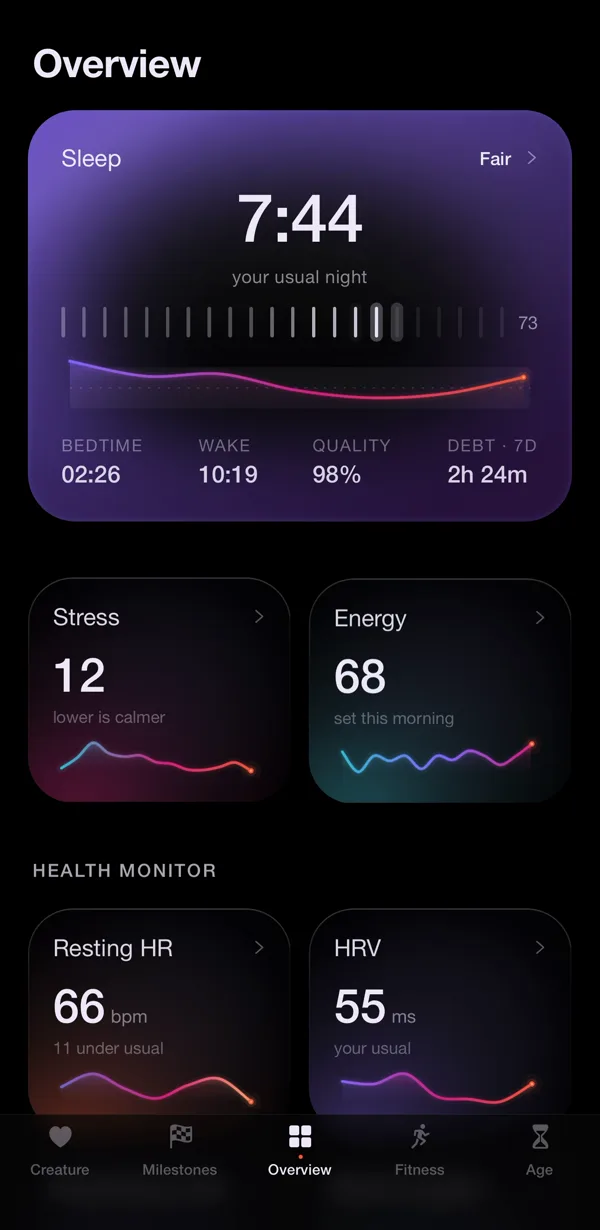
In the screen above, Stress sits at 12 and Energy at 68. The creature then has opinions about that, delivered in a morning verdict. It judges, it does not coach: it will not tell you to rest, train or do anything else, which is a change of pace from rings that nag. Your Energy number also stays private in friend mode: a friend sees only your mood word and a good-day count, as our guide to sleep tracking with a partner or friends explains. If you like a pet that reacts to your health data, our guide to virtual pet apps that use Apple Health compares the options.
The honest limitation: Nularo's Energy score is a morning read built from last night and yesterday. It is not a live gauge that drains as you go through the day the way Body Battery, Readiness or Bevel's Energy Bank do, and it is not a training tool. If you plan workouts around your score, use Readiness or one of the apps above. Nularo is iPhone only, works best with an Apple Watch writing HRV and sleep to Apple Health, and costs $39.99 a year with a 3-day free trial, or $9.99 a month.
Sources
- Apple Support: Understand your readiness score on Apple Watch
- Apple Support: Track your overnight and daytime vitals with Apple Watch
- Garmin Venu 4 series Owner's Manual: Body Battery
Try Nularo
Frequently asked questions
Does Apple Watch have a Body Battery?
Not by that name. Body Battery is Garmin's trademarked energy score. Apple's nearest feature is Readiness, a 0-10 score on Apple Watch Series 12 and Ultra 4 that weighs your recent activity, vitals and sleep.
Which Apple Watch models get the Readiness score?
Only Apple Watch Series 12 and Apple Watch Ultra 4, according to Apple's watchOS 27 user guide. Older watches that run watchOS 27 do not get the Readiness app, though they still have Vitals, sleep score, HRV and Training Load.
Is Apple's Readiness the same as Garmin Body Battery?
No. Body Battery is a 5 to 100 energy reserve that charges with sleep and drains with activity and stress. Readiness is a 0-10 score with four labels (Recover, Pace Yourself, Ready, Go For It) that also updates during the day. Similar idea, different scale and math.
What is the best body battery app for Apple Watch?
It depends what you want. Bevel's Energy Bank and Athlytic's Battery both track energy building and draining through the day from Apple Watch data. Vigor is a one-time $2.99 purchase that shows a 0-100 body energy score.
Does Nularo have a body battery score?
Nularo has an Energy score from 0 to 100, built from last night's sleep, your HRV and resting heart rate, and yesterday's exertion, compared with your own baseline. It is a morning read for fun, not a live gauge or a training tool.
Nularo is an entertainment and wellness app, not a medical device. Nothing on this page is medical advice. If something about your sleep or heart worries you, talk to a doctor.