Does Apple Watch have a recovery score? Three things called recovery
Updated November 3, 2026 · 7 min read · How we write these
 Nularo reads your Apple Health and turns it into a creature that reacts to how you really slept and moved.
Get it
Short answer
Yes on Apple Watch Series 12 and Ultra 4: watchOS 27 adds Readiness, a 0-10 score (Recover, Pace Yourself, Ready, Go For It) built from activity, vitals and sleep. Open the Readiness app on the watch, or Fitness on iPhone. Those two models also show Recovery HRV in the Heart Rate app. Older watches have no recovery score, but they do record Cardio Recovery (Health, Browse, Heart), the drop in heart rate one minute after a workout. Apps like Athlytic and Bevel add a Whoop-style recovery percentage.
You wake up, a friend with a Whoop is already announcing "62 percent, yellow day", and you swipe through your Apple Watch looking for your own number. Whether you find one depends on which watch is on your wrist. And Apple uses the word "recovery" for three different things, which does not help.
The short answer depends on your watch
Apple has never shipped a feature called "Recovery Score". What it has, as of watchOS 27, is three separate things with recovery in the description:
- Readiness, a daily score from 0 to 10. This is the real recovery score, and it is only on Apple Watch Series 12 and Apple Watch Ultra 4.
- Recovery HRV, a heart rate variability reading that Apple says is best for daily signals of stress and recovery. Also Series 12 and Ultra 4 only.
- Cardio Recovery, a Health app metric added with watchOS 9. It measures how fast your heart rate drops after a workout. It is not a daily score at all, and since it dates back to watchOS 9 it is not tied to the new models.
So if you bought a Series 12 or Ultra 4 this fall, yes, you have a recovery score. If you own a Series 11, Ultra 3, an SE or anything older, you do not, even on watchOS 27. You still have Cardio Recovery, the Vitals app, and the raw HRV and resting heart rate that third-party apps turn into a score.
Most pages ranking for this question either predate September 2026 (and say "no") or are App Store listings for apps that want to sell you the answer. Here is each piece, where it lives, and what it actually measures.
Readiness: Apple's recovery score on Series 12 and Ultra 4
According to Apple's support page, Readiness gives one score from 0 to 10 with a label:
- 0 to 1: Recover
- 2 to 4: Pace Yourself
- 5 to 7: Ready
- 8 to 10: Go For It
Apple lists three ingredients. Activity from today and recent days: active calories, workout effort ratings and Training Load. Vitals: the status of your overnight and daytime readings from the Vitals app. Sleep: last night's sleep score plus your recent history, so a run of short or irregular nights pulls it down. Unlike a Whoop-style morning number, it keeps moving. Apple says it updates through the day based on calories burned, naps and daytime heart rate.
To see it, open the Readiness app on the watch, or open Fitness on iPhone and tap Readiness. It needs setup first: your height, weight and age entered, Activity and Sleep set up, Overnight Vitals on, and at least 7 nights of wearing the watch to bed. Apple says it is for ages 13 and older and that it does not account for things like existing conditions or medications.
One fair caveat. WatchGeneration pointed out in September that Apple's white paper on the new heart sensor tests heart rate accuracy against six rival devices but does not test the overnight HRV that Readiness leans on. That does not make the score wrong. It means nobody outside Apple has validated it yet. If you came from Garmin, our guide to whether Apple Watch has a Body Battery compares Readiness with Garmin's gauge in more detail.
Recovery HRV: the input, not the score
Series 12 and Ultra 4 also changed how HRV is measured. Apple's newsroom says HRV is now taken as often as every five minutes, and it splits the number in two: Recovery HRV, for daily stress and recovery signals, and overall HRV, for longer-term health trends. To see Recovery HRV, open the Heart Rate app on the watch and turn the Digital Crown. Overnight Vitals on those models also checks Recovery HRV against your personal baseline.
This is a reading in milliseconds, not a 0 to 10 verdict. Think of it as one of the ingredients Readiness is cooked from. On older watches, HRV is still recorded, just in occasional spot readings when the watch decides you are still, and on a scale that does not match Whoop or Oura. That mismatch is why your Apple Watch HRV can look low next to a friend's band.
Cardio Recovery: the one older watches already have
Search the Health app on iPhone for "recovery" with an older watch and this is what you find. Apple's watchOS 9 notes describe it as a new Cardio Recovery metric estimated by Apple Watch, available in the Health app. Apple's developer documentation defines the underlying data as the drop in heart rate from your peak exercise rate to the rate one minute after the workout ended. So 25 means your heart rate fell 25 beats per minute in that first minute.
To find it: open Health on iPhone, tap Browse, tap Heart, then Cardio Recovery. Switch to the M or 6M view to see a trend instead of one workout.
It is easy to get no reading, which is the most common complaint in Apple Community threads. Users there report it shows up after Apple's own Workout app sessions such as outdoor runs, walks, hikes and outdoor cycling, and that the way you finish matters. If you keep walking for a few minutes before ending the workout, your heart rate has already come down, so the recorded drop looks smaller. Those are user reports rather than Apple documentation, so treat them as a starting point.
What Cardio Recovery does not do is tell you how recovered you are this morning. It describes one workout, after the fact. And this page will not tell you what number is good or bad for you. Compare similar workouts against each other over weeks, and take anything that worries you to a doctor.
Getting a Whoop-style recovery percentage on an older watch
For reference, Whoop's own support pages describe Recovery as a percentage from overnight data: HRV, resting heart rate, respiratory rate and sleep, plus skin temperature and blood oxygen on newer bands. Its bands are green at 67% and above, yellow from 34% to 66%, and red at 33% and below. That needs a Whoop band, not an Apple Watch.
Several iPhone apps rebuild the same idea from the data your watch already writes to Apple Health:
- Athlytic. Its App Store listing says it reads your overnight HRV and resting heart rate each morning against your own baseline and tells you how recovered you are. Free to download; Athlytic Pro is $4.99 a month or $29.99 a year in the US. It needs an Apple Watch for HRV and resting heart rate.
- Bevel. Bevel's help center describes Recovery as a 1% to 100% score calculated once each morning from resting heart rate, HRV, respiratory rate, SpO2 and wrist temperature, against rolling 60-day baselines that take 2 to 6 weeks to settle. On Series 12 and Ultra 4 it reads Apple's Recovery HRV directly. Recovery is on Bevel's free plan; Pro is $14.99 a month or $99.99 a year. Our free Bevel alternatives guide breaks down what Pro adds.
Each app uses its own math, so the same night can score 58 in one and 71 in another. Pick one and watch its trend. Many of the same apps also show a stress line, which we compare in our guide to free stress apps for Apple Watch.
Where Nularo fits
Nularo is an iPhone app with a small creature that lives on your Apple Health data. It reads sleep, sleep stages, HRV, resting heart rate, steps, active minutes and workouts, read-only, and you never log anything. It does not call anything a recovery score. Instead, each morning it turns last night into Sleep, Stress and Energy scores, compared with your own baseline, and the creature's mood (glowing, fine-but-judgy, wrecked or suspicious) is set against your own 14-day baseline.
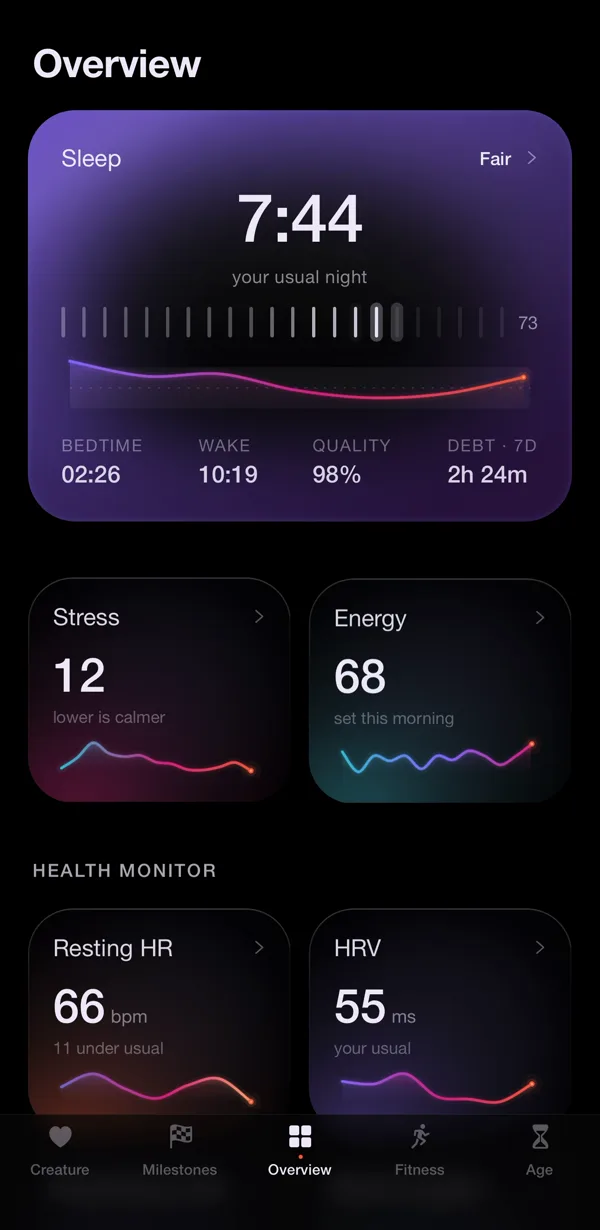
The Overview tab above shows sleep debt, Stress, Energy, resting heart rate and HRV on one screen, and the creature delivers a morning verdict about it. If short nights are dragging your numbers, our guide to whether Apple Watch tracks sleep debt explains what Apple counts.
The honest limitation: Nularo judges, it does not coach. It will not tell you whether to train hard or rest, which is the whole point of Readiness or Athlytic. If you plan workouts around a number, use one of those. Nularo is iPhone only, works best with an Apple Watch writing HRV and sleep to Apple Health, updates the morning after rather than through the day, and costs $39.99 a year with a 3-day free trial, or $9.99 a month.
Sources
- Apple Support: Understand your readiness score on Apple Watch
- Apple Newsroom: Introducing Apple Watch Series 12, with the all-new Health Sensing System
- Apple Developer: heartRateRecoveryOneMinute
- WHOOP Support: WHOOP Recovery
Try Nularo
Frequently asked questions
Does Apple Watch have a recovery score like Whoop?
Only on Apple Watch Series 12 and Ultra 4, where watchOS 27 adds a Readiness score from 0 to 10. Whoop's Recovery is a percentage from overnight HRV, resting heart rate, respiratory rate and sleep. Apple's Readiness also weighs your recent activity and updates during the day, so it is a close cousin, not a copy.
What is Cardio Recovery on Apple Watch?
It is a Health app metric added with watchOS 9. Apple's developer documentation defines it as the drop in heart rate from your peak during exercise to one minute after the workout ended. It is a single measurement per workout, not a daily score, and it only appears after some workouts.
Why does my Apple Watch not have the Readiness app?
Apple's support page says Readiness is available on Apple Watch Series 12 and Apple Watch Ultra 4 only, for ages 13 and older. Older watches on watchOS 27 do not get it. On a supported watch, it also needs at least 7 nights of sleep tracking with Overnight Vitals on before a score appears.
What is a good Cardio Recovery number?
This page will not give you a target, because the reading depends heavily on how the workout ended and how hard it was. The useful comparison is your own trend over similar workouts. If a change worries you, talk to a doctor.
Does Nularo give a recovery score?
Not under that name. Nularo shows Sleep, Stress and Energy scores each morning, built from your sleep, HRV and resting heart rate in Apple Health and compared with your own baseline. It is for fun and it judges rather than coaches, so it will not tell you whether to train.
Nularo is an entertainment and wellness app, not a medical device. Nothing on this page is medical advice. If something about your sleep or heart worries you, talk to a doctor.