Tamagotchi apps for self care: which pets forgive a bad week
Updated October 22, 2026 · 7 min read · How we write these
 Nularo reads your Apple Health and turns it into a creature that reacts to how you really slept and moved.
Get it
Short answer
The best-known self-care tamagotchi is Finch: free, a bird that grows when you finish small goals, with streak repairs and a Pause Mode for bad weeks. Kinder World swaps the pet for houseplants that never die. Quabble (a duck) and Urso (a pal with a home to upgrade) lean on guided exercises. Pengu is raised with a friend or partner, and Palli feeds pets on screen-time goals. All of these need you to tap. Nularo is the exception: it reads Apple Health instead, with a subscription.
You remember the egg-shaped Tamagotchi that died if you forgot it during a school trip. Now you want the grown-up version: a small creature that does better when you drink water, get outside and go to bed, without the guilt of a funeral when you have a rough week.
The free answer: your iPhone already has a mood log (no pet)
Before you install anything, know what Apple gives you. The Health app has a State of Mind log. On iPhone, open Health, tap Search (Browse on older versions), tap Mental Wellbeing, then tap State of Mind. You can log a momentary emotion or a daily mood, use a slider to show how you feel, and optionally add words and the things affecting you most.
Two details make it more useful than it sounds:
- Reminders. In State of Mind, scroll to the bottom, tap Options, and turn on During Your Day or End of Day reminders.
- Charts against your habits. Under Show in Charts, Apple lays your entries next to lifestyle factors such as exercise, sleep, daylight time and mindful minutes. That is the pattern-spotting most self-care apps charge for.
On Apple Watch, the same log lives in the Mindfulness app: open it, tap State of Mind, and turn the Digital Crown to pick how you feel. Entries land in the Health app on your phone.
What Apple does not give you is the thing you came for. There is no creature, no streak and nothing that looks happier when you look after yourself. That reward loop is the whole job of the apps below.
The key question: what happens on a bad week?
The original toy worked because neglect had consequences. That is also why it is a strange model for self care. The people searching for these apps are often having a hard time, and a pet that dies when you miss three days is a punishment for the exact moment you most need slack.
So most self-care pets quietly removed death. They differ on two things instead:
- What feeds the pet. Almost all of them run on things you tap: goals checked off, moods logged, breathing exercises finished. A few read data your phone or watch already records.
- What a missed day costs. Nothing at all, a streak you can repair, or a pet that visibly reacts to how you have been doing.
Pick on those two before you pick on art style. A pet you like the look of but that guilt-trips you will be deleted by week two.
Seven self-care pets, compared
Details are from each app's US App Store listing and, for Finch, its help center, checked in October 2026. Prices change, so check the offer in the app before paying.
| App | The pet | What feeds it | Missed days | Price |
|---|---|---|---|---|
| Finch | A bird | Goals, check-ins, reflections you log | Streak repairs and Pause Mode | Free, Finch Plus optional |
| Kinder World | Houseplants | Short self-care activities | Plants never die | Free, in-app purchases |
| Quabble | A duck | Mood log, gratitude, guided practices | Not described in listing | Free, in-app purchases |
| Urso | A pal with a home | Habits, goals, meditations | Not described in listing | Free, in-app purchases |
| Pengu (now "Friends") | A penguin and others | Feeding, mini-games, a friend | Not described in listing | Free, optional subscription |
| Palli | A pixel pet collection | Screen-time goals and quests | Not described in listing | Free, Pro $9.99/mo or $59.99/yr |
| Nularo | A creature | Apple Health data, no logging | Nothing dies; the mood shows the bad week | $39.99/yr (3-day trial) or $9.99/mo |
Finch: the default, and the most forgiving
Finch is the app most people mean by "self-care tamagotchi". You set small goals (getting out of bed counts), your bird gains energy when you finish them, and it goes on little adventures. There is a mood tracker, journaling prompts and breathing exercises. The core is free; Finch's help center lists Finch Plus at $9.99 a month or $69.99 a year, and Finch says the offer shown in the app is what counts.
Its answer to the bad-week problem is the best in the category. Your bird does not die. Finch tracks a streak, and its help center says a missed day can be repaired with Rainbow Stones, you earn a free Streak Repair Saver every 3 adventures (holding up to 2), and Pause Mode freezes the streak entirely while you are away. One small detail people miss: a Finch day resets about two hours before your set wake-up time, not at midnight. Finch does not read Apple Health, so everything it knows, you told it. If the cuteness or the tapping is the problem, see our Finch alternatives for adults.
Kinder World: no pet to keep alive
Kinder World replaces the animal with houseplants. Its listing describes two-minute sessions of gentle activities (naming an emotion, a gratitude prompt, breathing) while you raise and collect plants and decorate a home. The listing says it plainly: the plants never die. If even a forgiving streak feels like pressure, this is the lowest-stakes option here.
Quabble and Urso: a pet attached to guided exercises
Quabble gives you a duck and a space to decorate, plus a mood tracker, a gratitude diary, a 15-day program for building self-care habits and an anonymous community. Urso describes itself as a tamagotchi-like mindful game: you help a little pal grow and upgrade its home by doing small things for your wellbeing, with habit and goal tracking, reminders and guided meditations. Both are free with in-app purchases, and both are warmer and more exercise-led than Finch's goal list.
Pengu and Palli: the social one and the screen-time one
Pengu, now listed on the App Store as Friends (with Bao and Mellow joining Pengu), is less about self care than about company. You feed and play with a pet and raise it together with a partner or close friend, with a home-screen widget. Free with an optional subscription. If shared accountability is what you are after, we cover that side in sleep tracking with a partner or friends.
Palli feeds a pet collection on screen time. You set a daily intention (less scrolling, phone down before bed), it uses Apple's Screen Time tools to track and block apps, and hitting the goal earns tokens to pull new pixel pets. Newer versions add self-care quests like making your bed or going for a walk. Pro is $9.99 a month or $59.99 a year, and the listing flags that the app contains loot boxes, which is worth knowing if random rewards are a weak spot for you.
Pets that skip the check-in: Apple Health
Every app above has the same quiet weakness. On the days you are doing worst, you are least likely to open an app and log it, so the pet knows least exactly when it matters. A different group of pets avoids that by reading Apple Health. Steps, workouts and, with an Apple Watch, sleep and heart data get recorded whether or not you feel like tapping anything.
Most of those only eat steps (Nomi, Poki, Belly). Habitvs reads much more, including sleep and HRV, and is free. We compare them all in virtual pet apps that use Apple Health, and if sleep is the habit you most want a pet to care about, gamified sleep tracker apps covers Pokémon Sleep and SleepTown.
The trade-off is real. A Health-fed pet cannot see self care that leaves no data: calling a friend, eating a vegetable, crying it out. Logging apps can. Many people end up wanting one of each.
Where Nularo fits
Full disclosure: Nularo is our app, and it is the least self-care-y pet on this page, on purpose.
There is no check-in. Nularo reads Apple Health read-only: sleep and sleep stages, steps, active minutes, workouts, resting heart rate, HRV, respiratory rate and blood oxygen. Each morning you get a verdict notification and the creature lands in one of four moods (glowing, fine-but-judgy, wrecked or suspicious), measured against your own 14-day baseline rather than an ideal. A bad week shows on its face. Nothing dies, and because the baseline is your own recent average, it is judging you against you, not against a perfect stranger.
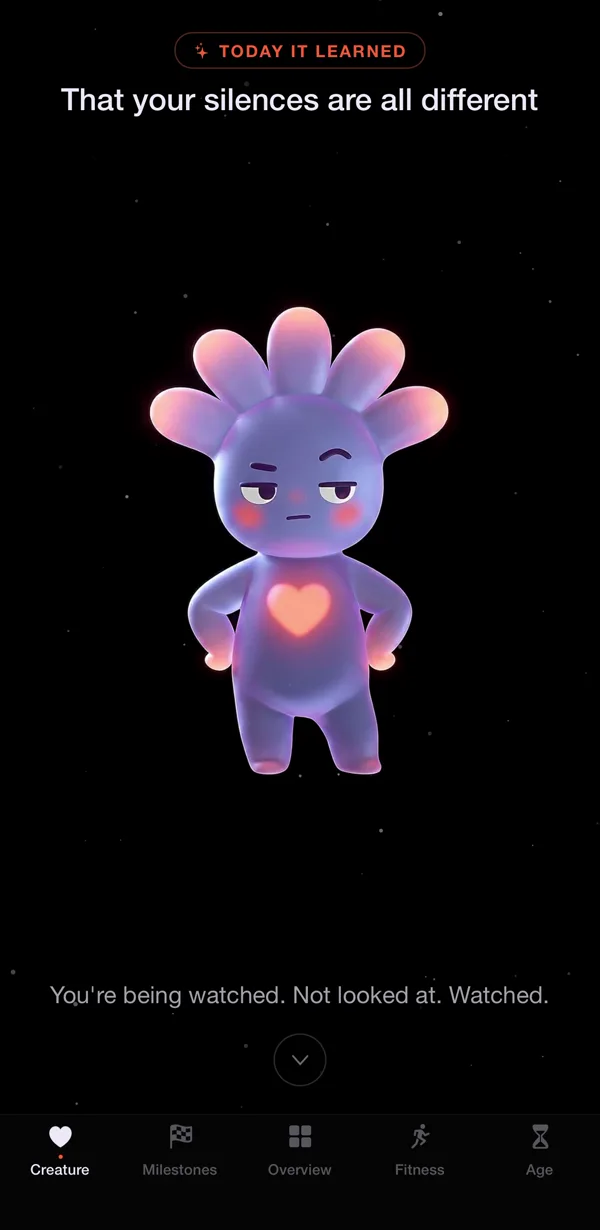
The tone is the opposite of Finch. The creature judges; it does not encourage, coach or give advice. If you like being roasted into bed on time, that works. (Other apps that roast you, for music, runs and selfies, exist too.) There is a Bedtime Pledge, optional evening Confessions and journal, a Weekly Report Card, and a weekly Creature Age, a for-fun number built from public-health guidelines and explained in biological age apps for Apple Watch.
The honest limitation: Nularo is not gentle, and on a genuinely hard week a sarcastic creature is not what everyone needs. Finch or Kinder World will be kinder. Nularo is also iPhone only, a subscription with a hard paywall after onboarding ($39.99 a year with a 3-day free trial, or $9.99 a month), and without an Apple Watch it has much less sleep and heart data to react to.
How to choose
If you want free, kind and forgiving, start with Finch. If any pet feels like pressure, take Kinder World's plants. If you want guided exercises with a mascot, try Quabble or Urso. If you want someone else in it with you, Pengu. If your phone is the problem, Palli. If you know you will never log anything, pick a pet that reads Apple Health. And whichever you pick: these are habit apps with a cute layer, not care. If you are struggling, talk to a doctor or a mental health professional.
Sources
- Apple Support: Log your state of mind in Health on iPhone
- Apple Support: Log your state of mind on Apple Watch
- Finch Help Center: Understanding Streaks and Pause Mode
- Kinder World on the App Store and Palli on the App Store
Try Nularo
Frequently asked questions
What is the best tamagotchi app for self care?
For most people it is Finch, because the core is free and it is built to be forgiving: missed days can be repaired and Pause Mode freezes your streak. If you want something calmer with no pet to keep alive, Kinder World's plants never die. If you hate logging, look at pets that read Apple Health instead.
Can your pet die in Finch?
No. Finch tracks a streak rather than your bird's survival. Its help center says a missed day can be repaired with Rainbow Stones, you earn a free Streak Repair Saver every 3 adventures (up to 2 saved), and Pause Mode freezes the streak while you are away.
Is there a self-care pet app that does not need daily check-ins?
Most self-care pets only react to what you tap in. Apps that read Apple Health, such as Habitvs, Nomi and Nularo, react to steps, sleep or heart data your iPhone and Apple Watch already record, so the pet changes without a check-in.
Is a self-care pet app a replacement for therapy?
No. These are habit and mood apps with a cute layer, and none of them is a medical or mental health treatment. If you are struggling, talk to a doctor or a mental health professional.
Is Nularo a self-care tamagotchi?
Half of one. Its creature reacts to how you have been treating yourself, but it reads Apple Health instead of asking you to log, and it judges rather than encourages. It is iPhone only and a subscription ($39.99 a year with a 3-day free trial, or $9.99 a month).
Nularo is an entertainment and wellness app, not a medical device. Nothing on this page is medical advice. If something about your sleep or heart worries you, talk to a doctor.